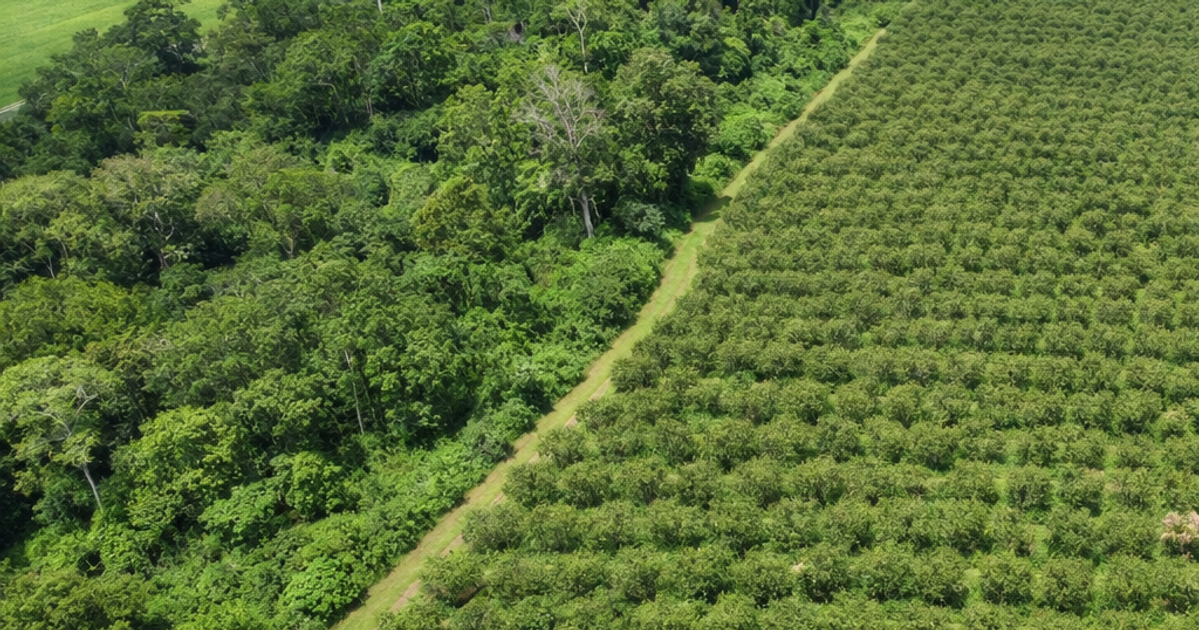

The image displays an orange grove integrated with windbreak structures (In San Julian – Bolivia)—a design we use to restore forest cover and reestablish biodiversity. This is the agroforestry model that the Ketrawe Foundation promotes among Bolivian farmers. Fortunately, adoption is growing daily as farmers see its profitability. We have proven that conservation and forest restoration are economically viable, even in the most deforested areas of the Amazon.
But why is this so critical?
A 2026 study by the University of Leeds calculates that every hectare of tropical rainforest produces 2.4 million liters of rainfall per year, a lifeline for crops like soy, sugarcane, sorghum, and cotton. Researchers estimate that this forest-generated rain contributes approximately €18.5 billion annually to the Brazilian agricultural sector.
The uncomfortable truth lies in the contrast: the massive economic value provided by these trees stands against a dismal level of investment in ecosystem protection. We are allowing an essential natural service—one that sustains harvests, drinking water, and energy production—to slip away.
In the Amazon, each square meter of forest contributes about 300 liters of rain annually through evapotranspiration. This is not just about volume; it is about consistency. This "infrastructure" works without reservoirs or pumps, as long as the trees remain standing.
The Economic Stakes: Bolivia vs. Brazil While this rainfall accounts for 0.93% of Brazil’s GDP, in Bolivia, it represents a staggering 5.91% of the national GDP. This makes Bolivia one of the most vulnerable nations in the region to deforestation-induced droughts. Our economic stability is tied to the canopy.
Current economic incentives in the region are failing. It is far more expensive to lose the forest than to protect it, yet this cost remains invisible in corporate and national accounting of all the countries that are part of the amazon basin. To put it in perspective we have chosen some of the most common crops in the area:
- Sugarcane: 1 m2 of crop requires the rainfall generated by 4 m2 of forest.
- Cotton: 1 m2 of crop depends on 2.3 m2 of forest.
- Soy: 1 m2 of crop relies on 1.7 m2 of forest.
The Real Cost of Deforestation With over 80 million hectares lost in recent decades, the Amazon has already seen a decline in water-generated value of more than €4.6 billion per year. The impact reaches far beyond the fields, affecting hydroelectric output, river transport, and urban water security.
At the Ketrawe Foundation, we do not pit conservation against production. Instead, we recognize a fundamental reality: without forests, there is no water stability. And without water, there is no viable agriculture. That is why we need to be partners with the forest if we want a sustainable future.